
How I answer kids’ questions about my daughter with Sanfilippo
Other children are often curious about Liv, 6, who's nonverbal
Written by |




“Is she a baby?” a child asks, pointing to my 6-year-old daughter with a pacifier in her mouth at the park.
“No, she’s 6, but she likes to put things in her mouth that she shouldn’t, like wood chips and rocks, so the pacifier helps keep her safe.”
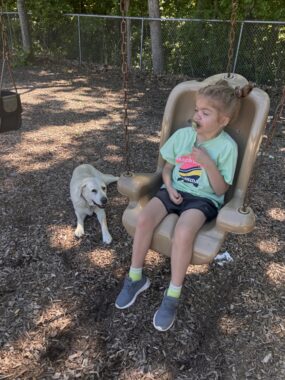
Liv swings at the park with her dog Remy. (Photo by Erin Stoop)
My daughter, Liv, has Sanfilippo syndrome, a terminal, neurodegenerative, genetic disorder. She’s regressed cognitively to about 1 year old. In addition to helping her keep unwanted things out of her mouth, her pacifier is also her security blanket. She’s very comforted by it.
Having a special needs child who is nonverbal, exhibits oral sensory seeking behavior, and doesn’t play like the average 6-year-old can create confusion for her peers at the park. She receives lots of stares, and, if a child is comfortable asking, I’ll be met with rapid-fire questions about why she’s acting in a way they find immature for her age.
Truthfully, I do not mind the questions at all. I would rather they ask than continue to stare, whisper, or mock Liv. I’ve seen all that behavior repeatedly, though it stings a little less each time. Thankfully, Liv is oblivious.

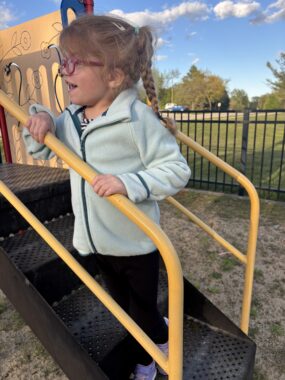
Liv is all smiles at the park as she climbs up the stairs. (Photo by Erin Stoop)
But kids are curious. So when they do get the courage to ask the question inside their head, my only concern is how to answer them. I consider the child’s age. If they’re young, usually my above comment about the pacifier suffices. Sometimes I’ll add, “She’s still learning.” If they’re a bit older, I may also say, “She finds comfort in her pacifier, because her brain works a little differently than yours.”
Depending on their daycare or school environment, Liv may be the first special needs child they’ve seen or interacted with. As long as the question comes from a place of curiosity — which, for young kids, is almost always the case — I want them to feel comfortable asking, and never ashamed. It’s how they learn and become more compassionate toward other people with special needs.
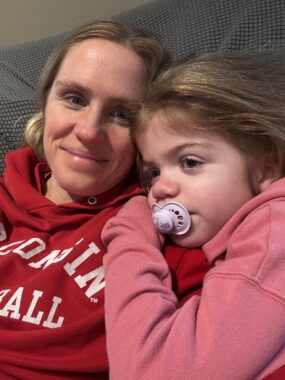
Erin and Liv cuddle on the couch. (Photo by Erin Stoop)
Parents sometimes ask me how they should respond if their child asks them questions instead of me. I tell them to encourage their child to come say hello. Because Liv is nonverbal, I usually tell kids, “Liv cannot talk, but she loves to play. She likes to make loud sounds, and that tells us she’s having fun.” That’s often enough to satisfy their curiosity, but it leaves the door open for more questions.
If their child is too shy to say hello, I tell parents to please say hi to me yourself. I’m never more than a few steps behind Liv. Telling your little one not to ask questions or that it’s rude to do so may make them hesitant to reach out to a friend with special needs in the future.
Personally, I love talking about Liv and sharing her story. Although her diagnosis is sad, I keep things light in these situations and focus on how happy she is. Young minds don’t need to be burdened by disease severity, just given simple but truthful answers. One day, they may realize how serious Liv’s condition is and appreciate the opportunity to be her friend.
Note: Sanfilippo News is strictly a news and information website about the syndrome. It does not provide medical advice, diagnosis, or treatment. This content is not intended to be a substitute for professional medical advice, diagnosis, or treatment. Always seek the advice of your physician or other qualified health provider with any questions you may have regarding a medical condition. Never disregard professional medical advice or delay in seeking it because of something you have read on this website. The opinions expressed in this column are not those of Sanfilippo News or its parent company, Bionews, and are intended to spark discussion about issues pertaining to Sanfilippo syndrome.

Leave a comment
Fill in the required fields to post. Your email address will not be published.