
Hope and anguish collide with news of the first Sanfilippo treatment
My 6-year-old, who has type B, isn't among those who may benefit
Written by |




On Sept. 13, “7News Spotlight” aired a special investigation titled “‘Miraculous in her averageness’: The young girl who could hold the key to curing dementia.” It highlights a beautiful 9-year-old girl from Australia named Tilly who has Sanfilippo syndrome. This neurodegenerative, terminal, genetic disorder is often referred to as childhood dementia, and my Liv also has it.
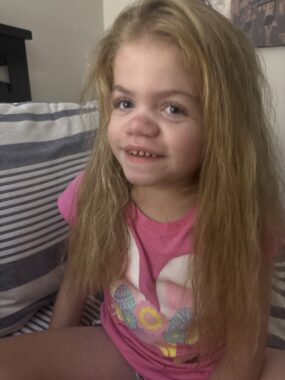
Liv, 6, shares a smile. (Courtesy of Erin Stoop)
Tilly received gene therapy through a clinical trial just after her first birthday, and the feature focused on how healthy she is today. She’s seen no negative effects of the disorder, whereas without the treatment, she’d likely have lost her ability to talk and experienced significant cognitive delays by age 9. It’s clear she has so much personality; in the video, she’s shown baking with her grandmother, playing a ball game at recess with her peers, and holding full, age-appropriate conversations.
Watching this, my heart broke in two, again, for my daughter. The trial was already full and well underway by the time Liv was diagnosed, and it’s for Sanfilippo type A, while Liv has type B. There have been no trial opportunities for type B since Liv’s diagnosis.
Liv, now 6, has already lost all her words, is losing her mobility, and her cognitive abilities are equivalent to those of a 9-month-old. To say the feature was heartbreaking for me to watch is an understatement. I couldn’t finish it at first.

For older kids, it’s too late
Tilly resembles Liv in many ways. They have the same glasses, the same thick and voluminous hair, the same button nose, and both have beautiful smiles. They could be sisters.
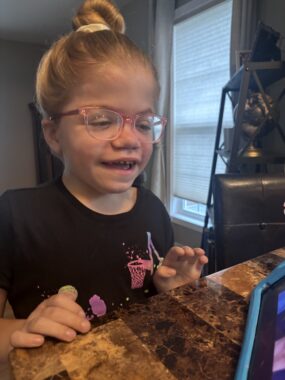
Liv laughs as she watches cartoons on her iPad. (Courtesy of Erin Stoop)
I haven’t cried this hard since the first few months after Liv’s diagnosis. What an amazing miracle this sweet girl Tilly is, yet how envious I am that she got this treatment and Liv didn’t. What would Liv be like today had she received gene therapy when she was young? What would her personality be like? What would she be into? My thoughts swirl.
The video also featured another girl with Sanfilippo who entered the trial at 8 years old but did not experience the same positive results as Tilly. “She was too far in her disease progression,” the girl’s mother said.
This points to the importance of early treatment, as gene therapy won’t reverse damage already done. For me, it reaffirms that even if Liv were to receive gene therapy now, it would be too late.
The next twist? The U.S. Food and Drug Administration (FDA) would soon be deciding whether to approve the same gene therapy for Sanfilippo syndrome. Four days later, on Sept. 17, the FDA approved Fayuvi (rebisufligene etisparvovec-hopf), making it the first treatment for Sanfilippo syndrome type A. The drug is expected to be shipped to treatment centers in as little as 30 days.
This miraculous treatment could give newly diagnosed children the chance at a healthy life. While I’d give anything for this to include Liv, I’m happy our community has a treatment after years of research, advocacy, and tears.
Happy tears flowed down my cheeks. Overwhelmingly happy, but mixed with a tinge of sadness.
Note: Sanfilippo News is strictly a news and information website about the syndrome. It does not provide medical advice, diagnosis, or treatment. This content is not intended to be a substitute for professional medical advice, diagnosis, or treatment. Always seek the advice of your physician or other qualified health provider with any questions you may have regarding a medical condition. Never disregard professional medical advice or delay in seeking it because of something you have read on this website. The opinions expressed in this column are not those of Sanfilippo News or its parent company, Bionews, and are intended to spark discussion about issues pertaining to Sanfilippo syndrome.




Leave a comment
Fill in the required fields to post. Your email address will not be published.