
Moving may be good for our daughter, but the thought of it seems daunting
Liv is 6 now, and in the last year, we’ve had to start thinking about accessibility
Written by |





When we received my daughter Liv’s Sanfilippo syndrome diagnosis four years ago, my mind raced with all the changes that would come — the therapies and medical appointments — and just how different her future suddenly looked. In an instant, her diagnosis had changed our lives forever.
Liv was diagnosed shortly after she turned 2. We were told that in the coming years, she would slowly lose her words and the ability to walk and feed herself. My head spun as I thought about what was to come.

Thinking about accessibility
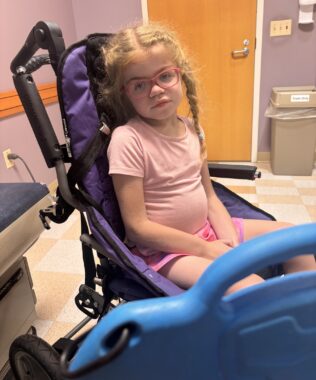
Liv looks at her iPad during a recent visit to the neurologist. (Courtesy of Erin Stoop)
At 2, Liv was a little behind her peers, but still reaching milestones, smiling, and talking. The thought of needing a wheelchair-accessible vehicle, of making modifications to our bathroom, and of possibly needing to move into a home with a bedroom on the first floor all crossed my mind, but I was able to keep them on the back burner. Those were way down the road, right?
I often say the challenges of Sanfilippo syndrome do not come all at once, and never overnight, but they do come eventually. Liv is 6 now, and in the last year, we’ve had to move those ideas off the back burner and start to seriously think about accessibility.
I can still pick up Liv, but it’s becoming harder for me. I worry that in a few years I may not be able to safely carry her upstairs, and that she may not be able to safely step into the bathtub. Making some home modifications is possible, but moving would let us pick a house that meets all of our needs.
But moving also seems daunting to me. We would love to have a house with a bedroom on the main floor and a separate in-law suite or guest room for family who come to help us. We would also like to move closer to my husband’s parents, who live two hours away. We would be starting over with a special needs school program and finding new respite providers and friends. It’s a mountain I’m not yet ready to climb.
Keeping the door open
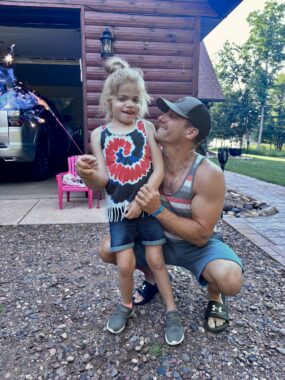
Liv and her dad, Tyler Stoop, celebrate Independence Day with a sparkler. (Courtesy of Erin Stoop)
Still, my husband and I often think about moving.
He’ll send me a house for sale on Zillow, and I’ll briefly allow myself to envision our family there. But I’m quickly put off by the thought of all the work that would come with a move (not to mention the price tag and high interest rates these days).
I also fear that, as Liv declines, new accessibility needs may arise, things I cannot predict. But I imagine that will be the case no matter what. As with every decision I make as a medical mom, I’ll make a decision about a new house with all the information I have in front of me, and with Liv’s best interests in mind.
For now, we will continue to modify our current home, even though we are aware that there may be a tipping point in the future when it just no longer works.
To avoid making a rushed decision, my husband and I keep this door open, pun intended. We’ll continue looking at other houses and decide to take the plunge when we find one that is best for our family.
At the end of the day, moving is hard, but ensuring that Liv grows up in a safe home must be our top priority.
Note: Sanfilippo News is strictly a news and information website about the syndrome. It does not provide medical advice, diagnosis, or treatment. This content is not intended to be a substitute for professional medical advice, diagnosis, or treatment. Always seek the advice of your physician or other qualified health provider with any questions you may have regarding a medical condition. Never disregard professional medical advice or delay in seeking it because of something you have read on this website. The opinions expressed in this column are not those of Sanfilippo News or its parent company, Bionews, and are intended to spark discussion about issues pertaining to Sanfilippo syndrome.

Leave a comment
Fill in the required fields to post. Your email address will not be published.