
Screen time is a lifeline for our daughter with Sanfilippo syndrome
If Liv's tablet keeps her engaged and happy, then I'm happy
Written by |





As a parent, I’ve met other moms who are proud that their children are “screen-free,” meaning they aren’t allowed to watch television on a tablet. I can’t relate in the least.
My 6-year-old daughter, Liv, thrives with screen time. She has a degenerative genetic disorder called Sanfilippo syndrome, which causes extreme hyperactivity, loss of attention, and developmental delays, among other symptoms.
When I say the TV or Liv’s tablet is on almost all the time, I’m not joking. Some mornings, we are lucky enough to get an hour of screen-free “playtime” when Liv is interested in playing with her toys. However, she can no longer role-play or pretend play. She’ll pick up a toy, maybe put it in her mouth, and then throw it down before grabbing another. But we are grateful she still shows some interest. As Sanfilippo progresses, her interest and ability to play with toys will continue to decline.

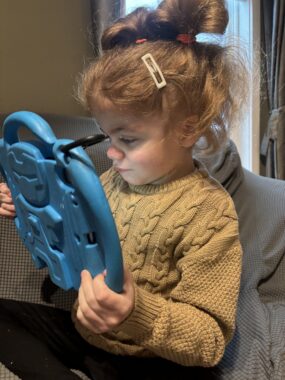
Liv watches her favorite show on the couch. (Photo by Erin Stoop)
After that first screen-free hour, she’ll watch TV while eating breakfast. Afterward, if she doesn’t have school, she’ll walk around our house with her tablet for almost the entire day. She’s not always paying attention to it, but it’s usually with her. She’ll go to her trampoline and jump with it, and then walk in circles around our house with it. Occasionally, she’ll stop to lean on the couch and watch something. Engaging Liv in activities is almost impossible; she likes to be on the move.
The tablet is always on during meals. She eats significantly better when it’s playing. Similar to her pacifier, the device helps her relax and settle down, almost like a comfort blanket.
Liv is cognitively about 1 year old and will continue to regress. We have no serious goals of improvement at this time, as there are no disease-modifying therapies available.
Liv’s happiness is paramount
Her tablet makes her happy, and therefore, her father and I are happy. Liv lights up when her favorite show is on. We also bring it to church and restaurants to help keep her still and engaged.
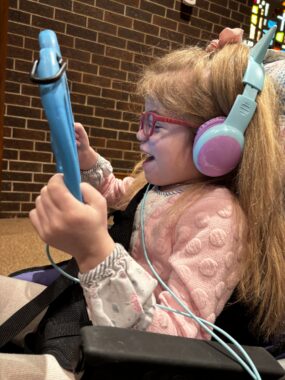
Liv watches her tablet at church. (Photo by Erin Stoop)
She can no longer tell us what she wants to watch, or even point to a choice on the screen. But we know exactly what she wants to watch by the way she reacts when we select a show. Kids with Sanfilippo syndrome often want to watch shows that they enjoyed as young toddlers. For us, that’s “Cocomelon,” “Dora the Explorer,” “Daniel Tiger’s Neighborhood,” and “Toy Story.” Those will likely remain Liv’s top picks for the rest of her life. We can occasionally deviate from these choices, but other shows won’t hold her attention like her “OG” shows do.
At the end of the day, I am unbothered by Liv’s screen time. What does bother me is that her younger brother, Liam, who will be 4 in May, wants to watch, too. It is difficult to explain why Liv gets to watch the tablet more than he does. My goal as a parent is to keep Liam engaged in other activities as much as possible. He loves watching “Spider-Man,” so it is his treat when he gets to relax with a show.
I’m not sure what we’d do without Liv’s tablet. We use the tool often and are truly grateful for it. Though I’ll never be able to say my kids are screen-free, I can wholeheartedly say I am meeting my daughter’s needs while keeping her happy!
Note: Sanfilippo News is strictly a news and information website about the syndrome. It does not provide medical advice, diagnosis, or treatment. This content is not intended to be a substitute for professional medical advice, diagnosis, or treatment. Always seek the advice of your physician or other qualified health provider with any questions you may have regarding a medical condition. Never disregard professional medical advice or delay in seeking it because of something you have read on this website. The opinions expressed in this column are not those of Sanfilippo News or its parent company, Bionews, and are intended to spark discussion about issues pertaining to Sanfilippo syndrome.



Leave a comment
Fill in the required fields to post. Your email address will not be published.