
Being a Sanfilippo parent means facing impossible decisions
Do we pursue clinical trials for our 6-year-old daughter?
Written by |





“What would Liv want?” This is a question I ask myself every day.
Our 6-year-old daughter, Liv, has a neurodegenerative genetic disorder called Sanfilippo syndrome. She can no longer say yes or no, point to what she wants, or even nod her head.
What does she want to wear? Does she want to go outside? What would she like to eat for lunch? These simple questions have become second nature for me to answer on her behalf, often without much thought.
If only all decisions in life were that simple, I could learn to be OK with making all of them myself. With Sanfilippo syndrome come monumental decisions, like whether or not to pursue a clinical trial. Could we do more harm than good? Would this make her happier? Would Liv want to travel weekly for an infusion into her brain? What if we extend her life, but it’s not a good quality of life?

A turning point
Liv reached her cognitive peak several years ago. In the past year, she’s lost almost all of her speech, her thumbs have bent at 90 degrees — making picking up food challenging — and she’s struggling more with stairs. She was never able to be potty-trained and requires full supervision due to a lack of safety awareness. She will continue to regress, eventually losing her ability to walk and eat by mouth in the coming years. Life expectancy is mid to late teens.
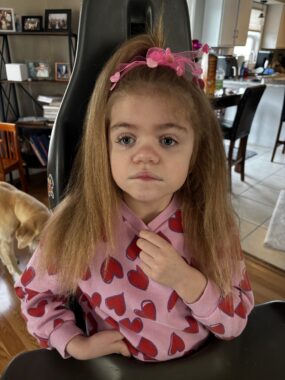
Liv poses for a Valentine’s Day photo. As her Sanfilippo syndrome progresses, her parents face impossible decisions. (Photo by Erin Stoop)
If a drug trial opportunity had been available to us shortly after her diagnosis — before regression — I would’ve said yes in a heartbeat. Now, it’s a different story. Liv has suffered considerable, irreversible brain damage. We know that potential treatments on the horizon are not going to cure her. They may slow the progression and improve her quality of life for a time, but ultimately, Sanfilippo will continue to damage her organs and take her from us.
I desperately wish I could ask Liv what she would want us to do. I understand that major medical decisions would never be left to a 6-year-old, but I would give anything for a heart-to-heart conversation with my daughter.
My husband and I talk about the possibility of enrolling Liv in a trial if one becomes available, but we no longer see eye to eye on this decision, which makes it even harder to bear. He desperately wants to freeze Liv in her current state, knowing that harder years are ahead. I, on the other hand, do not want to put her through something so demanding if there is no guarantee that her life wouldn’t simply be harder for longer. I’d much rather cherish the time we have, spending it with family and friends, and not at the hospital every week. I don’t want to look back and regret spending these easier years in medical settings instead of at home.
This month marks four years since Liv’s diagnosis in 2022. It’s hard to believe so much time has passed. It’s disheartening that no trial has been available to her. We’ve never had to make an extremely tough decision, only hypothetical ones.
We are at a turning point in Liv’s journey. She’s right on the edge, age-wise, of eligibility for a trial, as children with similar regression can no longer show as much benefit from medication trials.
If something becomes available, I have no doubt we will sit down and carefully weigh the pros and cons. The decision will not come lightly, but I know it will be made with our deepest love for Liv and our family.
Note: Sanfilippo News is strictly a news and information website about the syndrome. It does not provide medical advice, diagnosis, or treatment. This content is not intended to be a substitute for professional medical advice, diagnosis, or treatment. Always seek the advice of your physician or other qualified health provider with any questions you may have regarding a medical condition. Never disregard professional medical advice or delay in seeking it because of something you have read on this website. The opinions expressed in this column are not those of Sanfilippo News or its parent company, Bionews, and are intended to spark discussion about issues pertaining to Sanfilippo syndrome.


Leave a comment
Fill in the required fields to post. Your email address will not be published.