Fayuvi (rebisufligene etisparvovec-hopf) for Sanfilippo syndrome
 Fact-checked by
What is Fayuvi for Sanfilippo?
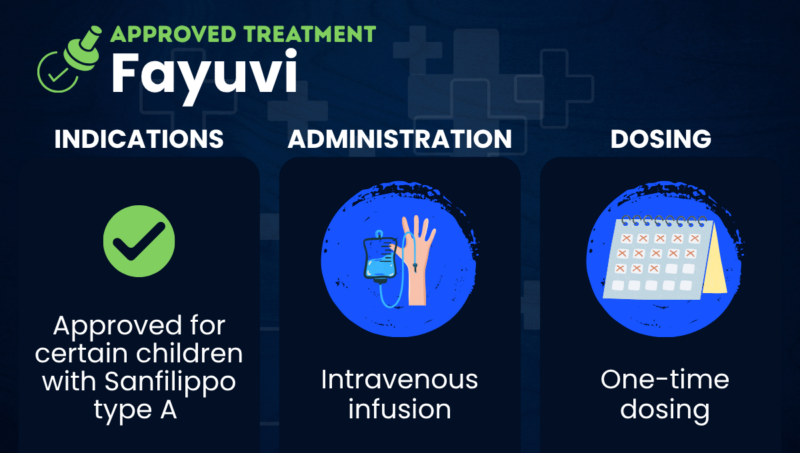
Fayuvi (rebisufligene etisparvovec-hopf) is a one-time gene therapy approved to treat certain children with Sanfilippo syndrome type A. When used in youngsters with preserved neurodevelopmental function, it may help slow or stop the progression of neurological symptoms.
In Sanfilippo type A, mutations in the SGSH gene lead to the harmful accumulation of a large sugar molecule called heparan sulfate in brain cells, driving progressive neurological damage.
Administered as a one-time intravenous, or into-the-vein, infusion, Fayuvi delivers a healthy version of the SGSH gene to cells, providing them with the tools they need to clear toxic heparan sulfate. Such treatment is expected to slow disease progression. The gene is packaged into a viral carrier that helps it be taken up by human cells.
Ultragenyx Pharmaceutical markets Fayuvi, which in September 2026 became the first-ever treatment for Sanfilippo type A approved by the U.S. Food and Drug Administration.
Therapy snapshot
| Brand name | Fayuvi |
| Chemical name | Rebisufligene etisparvovec-hopf |
| Usage | Used to slow disease progression in children with Sanfilippo syndrome type A |
| Administration | One-time intravenous infusion |
Who can take Fayuvi?
In the U.S., Fayuvi is approved to treat the neurological manifestations of Sanfilippo A in children with preserved neurodevelopmental function.
There are no contraindications for its use, although Fayuvi is not recommended for people who have preexisting antibodies against the therapy’s viral carrier, called adeno-associated virus serotype 9 (AAV9).
How is Fayuvi administered?
Fayuvi is administered as a single intravenous infusion at a recommended dose of 30 trillion vector genomes per kilogram of body weight. It is administered by a healthcare provider over approximately one hour.
Starting the day before the infusion, patients will receive oral corticosteroids, a class of anti-inflammatory medications that can help prevent certain immune-related complications after gene therapy. Their use will usually continue for about two months and then be slowly tapered off.
Fayuvi in clinical trials
Fayuvi’s approval was supported by data from 17 children with Sanfilippo A who received the gene therapy at its recommended dose in the Phase 2/3 Transpher A clinical trial (NCT02716246). All of these children were no older than 2, or older than 2 but with only mild or moderate neurodevelopmental impairments.
The younsters were monitored for two years after receiving Fayuvi in Transpher A, and then entered a long-term follow-up study (NCT04360265) for further monitoring. In total, participants were followed for a median of 4.2 years across the studies.
Compared with an external natural history group of untreated children with Sanfilippo A, those receiving Fayuvi achieved a significant 23.5-point improvement on the Bayley-III Cognitive Scale, which assesses cognitive development in children ages 2 to 5.
Specifically, children given the gene therapy gained a mean of 16 points over the tracking period, reflecting improvements in or maintenance of developmental skills. The untreated group, meanwhile, saw declines of a mean of 7.6 points, reflecting a loss of developmental skills.
Fayuvi side effects
The most common side effects associated with Fayuvi are:
- elevated liver enzymes, which could signal liver damage
- vomiting
- fever
- reduced numbers of white blood cells
- reduced numbers of platelets, the cell fragments that help blood clot after an injury
- decreased appetite
- nausea
- increases in amylase, a digestive enzyme
Liver function and platelet counts are assessed before a patient receives Fayuvi and periodically for some time after treatment to ensure that more serious complications don’t arise from these side effects.
Fayuvi may also cause immune reactions during infusion, including a serious reaction called anaphylaxis. Patients will be closely monitored, and if a reaction occurs, the infusion may be paused or slowed down.
Other gene therapies that use an AAV viral carrier have been associated with thrombotic microangiopathy — a serious complication in which small clots form in blood vessels and block blood flow — but this has not been seen with Fayuvi.
Some gene therapies, including Fayuvi, carry a theoretical risk of cancer, which could happen if the AAV carrier mistakenly inserts genetic material into the wrong spot in a person’s DNA.
Sanfilippo Syndrome News is strictly a news and information website about the disease. It does not provide medical advice, diagnosis, or treatment. This content is not intended to be a substitute for professional medical advice, diagnosis, or treatment. Always seek the advice of your physician or other qualified health provider with any questions you may have regarding a medical condition. Never disregard professional medical advice or delay in seeking it because of something you have read on this website.